

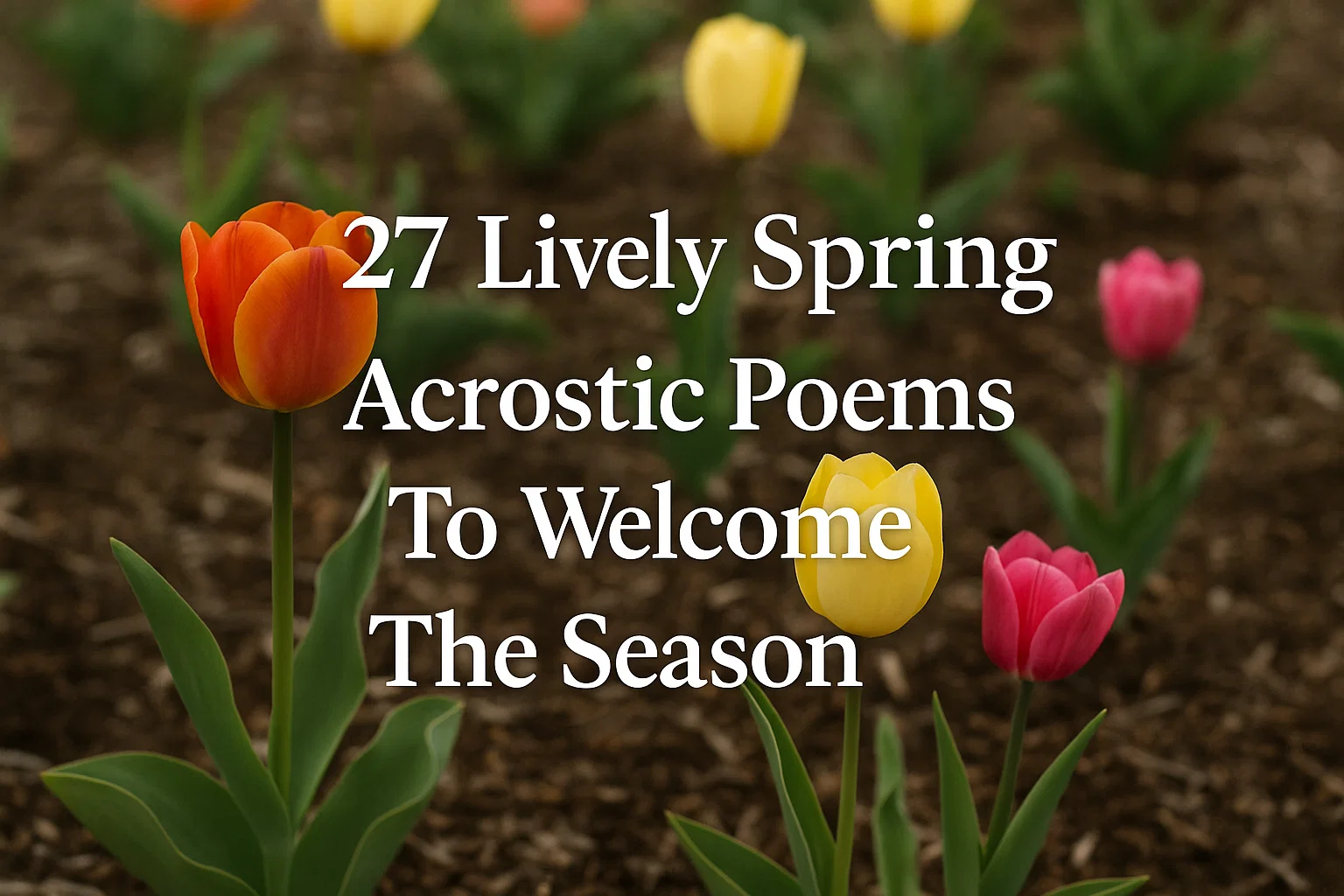
I don’t know about you, but by the time February finally drags its heels out the door, I am absolutely desperate for color. I’m tired. I’m tired of the gray slush that piles up against my porch steps like uninvited guests. I’m done with the heavy coats that make me feel like a walking marshmallow every time I have to run to the grocery store. I want green. I want birds that actually sing instead of just shivering on a wire looking miserable.
That anticipation? It’s the perfect fuel for creativity.
Back when I was teaching third grade, that transition from winter to spring was always electric. You could feel the energy in the hallway. The kids felt it too—they were twitchy, staring out the window, watching for that first brave crocus to punch through the thawing mud. That’s when I discovered the absolute magic of Spring Acrostic Poems.
We aren’t talking about high-brow sonnets here. We are talking about accessible, vibrant, messy creativity that captures that restless, hopeful energy perfectly. Whether you are a teacher looking for a classroom activity that won’t result in glazed-over eyes, a parent wanting to celebrate the equinox without buying more plastic junk, or just someone who loves the rhythm of the seasons, these poems are for you.
More in Poems Category
Key Takeaways
- Accessible Creativity: Acrostics strip away the panic of rhyming, making poetry doable for anyone who can spell a word vertically.
- Real Vocabulary: These are unmatched for teaching kids (and adults) how to move beyond words like “good” or “nice.”
- Mindfulness: Writing about the season forces you to actually look at it, connecting you to the mud and the buds.
- Versatility: Use these as templates. Steal them. Remix them. They are starting blocks, not finish lines.
Why on Earth Do We Love Acrostic Poems So Much?
Have you ever stared at a blank page, feeling that intimidating blink of the cursor? It’s paralyzed me more times than I care to admit. It’s the writer’s block equivalent of a stare-down. The beauty of an acrostic poem is that the structure does the heavy lifting for you. You have your anchor. The vertical word is your map, and you just have to fill in the landscape.
For children, especially, this is liberating. I remember a student named Leo who absolutely loathed writing time. He would snap his pencil lead on purpose just to get up and walk to the sharpener. But one Tuesday in March, I put the word “STORM” vertically on the board. I didn’t ask for a paragraph. I just asked for words describing thunder. His hand shot up. He didn’t have to worry about stanzas or meter. He just needed to describe the noise.
But don’t let the simplicity fool you. You can pack a profound emotional punch into a few vertical letters.
Can We Actually Capture the Chaos of March?
March is a tricky beast. It’s a lion, it’s a lamb, and mostly, where I live, it’s just a muddy mess. It teases you. One day it’s 60 degrees, and you’re ready to burn your parka. The next day? Snow flurries. That dichotomy makes for excellent poetry because it’s full of conflict.
1. MARCH
I wrote this one looking at my hallway floor, which was covered in boot prints.
Mud covers my favorite boots Air feels crisp but not biting Ready for the sun to stay Coats are unzipped finally Happy days are coming back
2. THAW
There is a specific sound to the thaw—the drip, drip, drip of the gutters. It’s the sound of the earth waking up with a hangover.
Trickling water everywhere Hard ground turns to mush Away goes the white snow Waking up the sleeping earth
3. WINDY
March wind isn’t a gentle breeze. It’s an aggressive force that knocks over your trash cans.
Whistling through the bare trees Invisible hands pushing me Never stopping to take a breath Drying up the puddles fast Yelling down the chimney flue
Do you see how simple that is? We aren’t trying to be Shakespeare here. We are just trying to paint a picture. When I write about the wind, I think about hanging laundry on the line for the first time in months, watching sheets snap and dance like ghosts. That’s the energy we want.
What About the Flowers That Finally Decide to Bloom?
Nothing says “spring” like the first splash of color. I have a small garden patch in my backyard—and when I say small, I mean it’s basically a dirt square. But I guard my tulips with the ferocity of a dragon guarding gold. The deer in my neighborhood know I’m watching. I’ve literally run out onto my porch in my bathrobe to shoo them away.
Flower acrostics are wonderful because they force us to look at the details. We aren’t just seeing a “flower.” We are seeing petals, stems, colors, and sunlight.
4. TULIP
My tribute to the survivors of the deer raids.
Turning heads with bright red Under the sun standing tall Lovely cup shape holds the dew In the garden, you are queen Please don’t let the deer eat you
5. BLOOM
This is about that sudden explosion of life that happens overnight.
Bursting open just for us Life returns to garden beds Orange, purple, pink and white Opening to drink the rain Making the world soft again
6. DAFFODIL
I love using “Daffodil” because it’s a longer word. It challenges you to keep the momentum going. If you are doing this with kids, encourage them to use a thesaurus. “Delightful” is a great word that might not come up in everyday conversation over cereal.
Dancing yellow heads bobbing Always the first to say hello Frumpets blasting silent tunes Fields of gold across the lawn Orange centers look like cups Delightful sight for weary eyes Ignoring the last frost bite Long green stems strong and proud
How Do We Celebrate the Return of the Sun?
After months of darkness where it feels like night falls at 4:00 PM, the return of sunlight changes everything. It changes our mood, our sleep, and even how our houses look (suddenly I see all the dust bunnies I ignored in January because the sun is highlighting them like a spotlight).
Writing about the sun requires sensory language. Does it feel warm? Does it glare? Is it shy?
7. SUNSHINE
Shadows stretch out long and thin Underneath the warming rays No more heavy winter gloom Skin feels happy once again Heating up the sidewalk concrete Inviting us to play outdoors Nature smiles at the light Everything looks bright and new
8. LIGHT
This one is about that mental shift. You know the one—when you suddenly feel like maybe, just maybe, you can tackle that project you put off all winter.
Lifting up my heavy spirits Into every dark corner Glowing gold upon the grass Heating up the chilly soil Time to put the lamps away
9. WARMTH
Wearing t-shirts feels so good Away with scarfs and woolen hats Running without slipping down Melting icicles drip drop Taking walks around the block Happiness is feeling hot
What About the Inevitable Spring Rain?
You can’t have the flowers without the showers. I used to hate the rain. It creates frizz. It tracks mud into the hallway. It ruins plans. But one afternoon a few years ago, I sat on my porch during a thunderstorm. The smell—petrichor—was intoxicating. It smelled like growth. It smelled like the earth was taking a deep breath.
Now, I try to teach that appreciation. Rain isn’t “bad weather.” It’s a drink for the earth.
10. PUDDLE
Kids and puddles are magnetic. You can tell them “don’t jump,” but their legs will do it anyway.
Parking lot is full of lakes Underneath the grayest clouds Droplets making tiny rings Diving in with rubber boots Laughing as the water splash Everyone gets soaking wet
11. RAINCOAT
I had this bright yellow raincoat in college. I looked like a giant banana, but I stayed dry.
Ready for the stormy day Always keeps me dry inside It is bright and shiny yellow Never lets the water in Covers up my school outfit Outside I am waterproof Arms are snug and warm today Time to jump and make a splash
12. STORM
Sky turns dark and ominous Thunder grumbles overhead Over all the hills and trees Rain comes down in heavy sheets Making music on the roof
Notice the verbs here: Grumbles, Making, Covers, Diving. Spring Acrostic Poems thrive on active verbs. Passive voice kills the energy of a poem faster than a frost kills a seedling.
Can We Catch the Sounds of Spring?
Spring is noisy. Winter is silent and muffled by snow, but spring is a cacophony. The birds are arguably the loudest and most joyous part of the equation.
I have a robin that builds a nest in the wreath on my front door every single year. It drives my husband crazy because we can’t use the front door for weeks; we have to go through the garage. But I love it. I love hearing the babies peep. It’s worth the inconvenience.
13. ROBIN
Red breast bright against the lawn Outside hunting for a worm Bobbing head and watching me In the tree your nest is safe New eggs hatching very soon
14. CHIRP
Calling out to all your friends High above in maple trees In the morning waking me Ready to start up the day Party time for all the birds
15. BIRDS
Building nests with twigs and string In the air they swoop and dive Returning from the southern lands Downy feathers soft and smooth Singing songs of pure delight
What Do We Actually Do in Spring?
It’s not just about looking at nature; it’s about getting your hands dirty in it. Spring is baseball season. It’s kite-flying weather. It’s the time to plant seeds and pray they grow.
One of my fondest/worst memories is trying to fly a kite with my niece. We spent twenty minutes untangling string—which is its own circle of hell—and running like maniacs, only for the kite to crash into the only tree in the entire park. We laughed until our sides hurt. That memory? That’s a poem waiting to happen.
16. KITE
Keeping eyes upon the sky Into clouds it soars away Tugging hard upon the string Eagle of paper and of wood
17. PLAY
Parks are full of happy kids Laughing on the swinging set All my friends are here today Yes, we stay out until dark
18. GARDEN
This is where the real work happens.
Grab the shovel and the rake Always pulling up the weeds Rows of lettuce and of peas Digging deep into the dirt Earthworms wriggle in the soil Nature gives us food to eat
19. BASEBALL
The smell of hot dogs, the dust, the uncomfortable metal bleachers. It’s a vibe.
Batter standing at the plate All the fans are cheering loud Swing the bat with all your might Everyone looks at the ball Bases loaded, run on home After school we practice hard Love to hear the umpire shout
How Do We Handle Spring Holidays?
Easter and Earth Day are the big anchors of the season. They provide specific imagery—eggs, bunnies, recycling, trees—that makes acrostic writing very straightforward.
20. EASTER
Eggs are hidden in the grass All the kids run fast to look Sunday morning best attire Treats of chocolate and of sweet Eating ham and jellybeans Rabbits hopping down the trail
21. EARTH
This is a great one for the classroom to teach responsibility.
Every day we must protect All the rivers and the trees Reduce the trash we throw away Take good care of animals Help our planet stay alive
What About the Feeling of Growth?
Sometimes we want to get a little more abstract. Spring is a metaphor for starting over. It’s about second chances. It’s about cleaning out the junk drawer of your life.
22. GROW
Getting taller every day Reaching up to touch the sun Opening new leaves so green Watching nature do its work
23. ALIVE
All the world wakes up again Life is buzzing in the air Insects humming in the yard Vines are climbing up the wall Everything feels fresh and new
24. FRESH
Feeling clean and brand new Ready for a different start Energy is rising up Smells like grass and turning soil Happy thoughts are in my head
Are There Creepy Crawlies?
We can’t ignore the insects. I admit, I am not a fan of bugs in my house—if I see a centipede, I am moving out—but in the garden, they are essential. And kids? Kids love bugs. They love roly-polys and ladybugs. They will hold them in their hands and name them.
25. BUG
Big and small they crawl around Underneath the heavy rocks Going about their busy day
26. BEE
Buzzing by the flower bed Eating nectar for their hive Every stripe is black and gold
27. SPRING (The Grand Finale)
Let’s end with the big one. The word that encompasses it all.
Sunshine melts the winter ice Playing outside until late Rains showers bring the flowers out Insects waking from their sleep New leaves growing on the trees Greatest season of them all
Real Tips for Writing Your Own Spring Acrostic Poems
You have read 27 examples, but the real fun begins when you pick up your own pen. Or when you hand a marker to a child. How do you get past the initial block?
Brainstorm First, Write Second
Don’t try to write the lines immediately. That’s a recipe for frustration. If you choose the word “BUTTERFLY,” write it vertically. Then, on a separate piece of paper, write down every word you associate with butterflies. Wings. Orange. Flying. Cocoon. Soft. Tiny.
Once you have your “word bank,” the puzzle pieces fit together much easier. It’s like cooking—mise en place. Prep your ingredients before you turn on the stove.
Focus on the Five Senses
I tell this to writers of all ages: Show, don’t tell.
- Don’t just say the flower is pretty. Tell me it feels like velvet.
- Don’t just say the rain is wet. Tell me it tastes cold on your tongue.
- Don’t just say the mud is dirty. Tell me it makes a sucking sound when you pull your boot out.
Sensory details are the spice of poetry. Without them, you’re just serving plain white rice. Bland.
Use a Thesaurus
This is a great opportunity to expand vocabulary. Instead of “Green,” try Emerald, Lime, or Moss. Instead of “Wet,” try Drenched, Soaked, or Damp. It makes the poem sound smarter, and frankly, it makes you feel smarter writing it.
Don’t Worry About Rhyme
I cannot stress this enough. Acrostic poems can rhyme, but they absolutely do not have to. In fact, trying to force a rhyme often ruins the natural flow of the imagery. You end up writing nonsense just to match “cat” with “bat.” Let the words breathe. If a rhyme happens naturally, great. If not, let it go.
Bringing It All Together
Spring is fleeting. In many parts of the country, it feels like we blink and suddenly it’s ninety degrees and humid. That’s why capturing these moments in writing is so important. It forces us to slow down. It forces us to notice the gradual greening of the lawn and the specific shade of blue in the April sky.
So, grab a notebook. Look out your window. What do you see? Is there a robin tugging at a worm? Is there a bud on the oak tree that wasn’t there yesterday?
Write the word down vertically. Fill in the lines. Celebrate the season.
These Spring Acrostic Poems are more than just words on a page; they are a welcome mat for the warmth to come. Happy writing!
FAQs
What is the main benefit of using acrostic poems to celebrate spring?
Using acrostic poems makes poetry accessible and helps people connect with the season by visually and creatively exploring words related to spring, fostering mindfulness and vocabulary development.
How can I start writing my own spring acrostic poem if I feel stuck?
Begin by brainstorming related words for your chosen season, write the vertical word first, then list associated words separately to build your poem, and focus on using sensory details for vivid imagery.
Why is it important to focus on verbs and active language in spring acrostic poems?
Active verbs and energetic language bring the poem to life, capturing the lively, chaotic spirit of spring weather and nature, making imagery more vivid and engaging.
How do spring acrostic poems help children learn new vocabulary?
They encourage children to explore descriptive words, expand their vocabulary with the help of thesauruses, and articulate more detailed, textured imagery through the structure of the poem.
What role does sensory detail play in creating effective spring-themed acrostic poems?
Sensory details make the poem more vivid and tangible, allowing the reader to experience the season’s sights, sounds, smells, and textures, which deepens the emotional and aesthetic impact of the poem.