
I was sitting on my back porch in Virginia this morning, clutching a mug of coffee that was rapidly losing its heat, staring at a patch of dirt. It’s early spring here, the kind of gray, wet morning that makes you wonder if the sun has permanently retired. But there, pushing through the mud and the decaying leaves of last November, was a single, stubborn crocus. Purple and defiant. It didn’t care about the frost. It just needed to bloom.
That little flash of color did something to my chest. It loosened a knot I didn’t even know I was carrying. That, right there, is exactly why I keep coming back to beautiful poems about flowers.
We aren’t just looking for pretty rhymes about roses. We are looking for grit. We are looking for resilience. Whether I’m celebrating a massive work victory or trying to glue the pieces of a broken heart back together, poetry about blooms anchors me in a way that self-help books never quite manage.
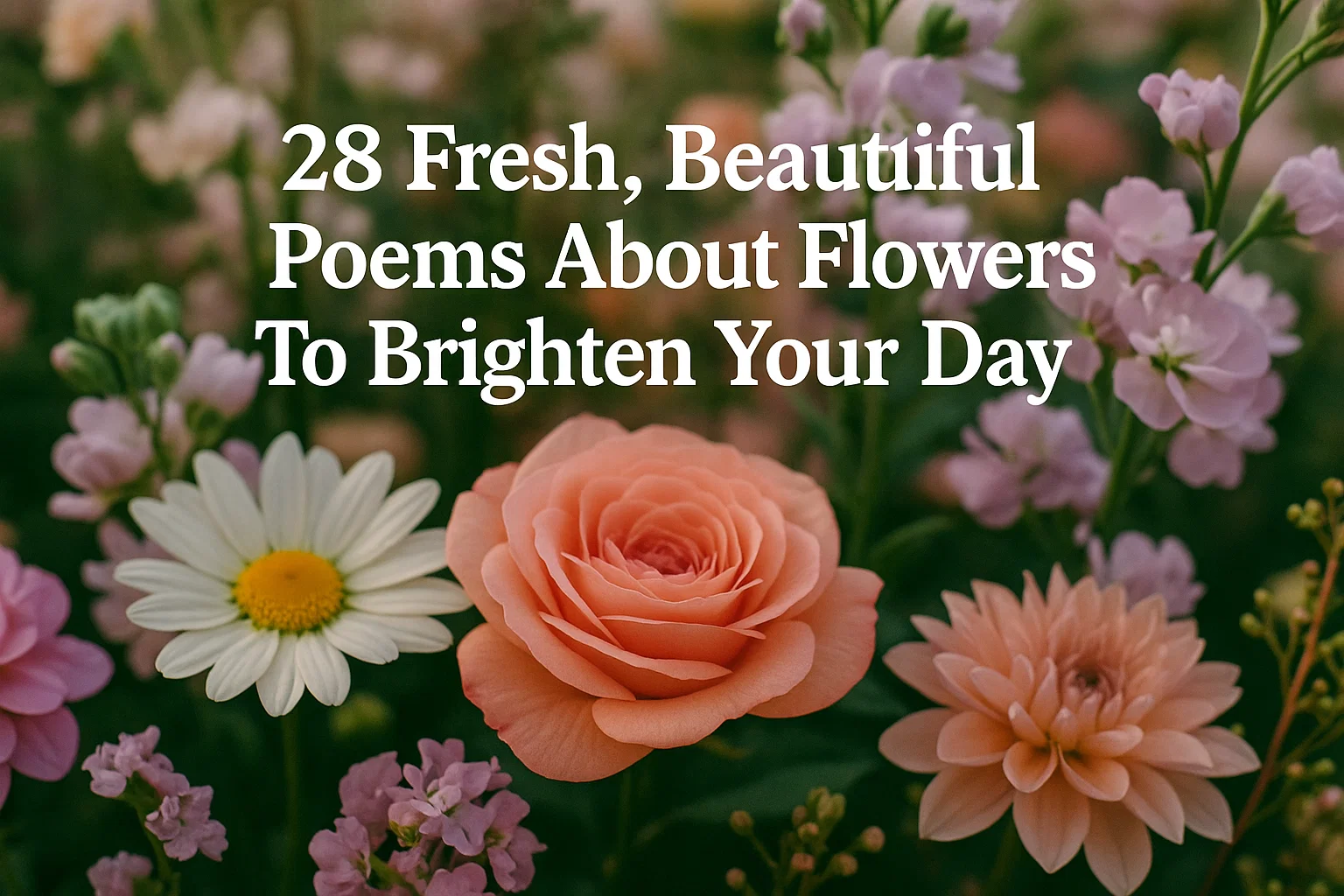
So, I’ve dug through my dog-eared anthologies and my messy digital notes to bring you 28 poems that actually mean something. Some are classics you might have skimmed in high school; others are hidden gems I found buried in obscure literary journals. But all of them are fresh, alive, and ready to sit with you.
More in Poems Category
Key Takeaways
- Nature is Cheaper Than Therapy: Reading poetry about flora mirrors our own human resilience, offering a quiet, reflective space to process emotions without a co-pay.
- Weeds Are Just Misunderstood Art: Shifting your focus from the perfectly cultivated rose to the stubborn dandelion changes how you see your own “flaws.”
- The Victorian Secret Code: Learning the basics of floriography (the language of flowers) turns reading these poems into a treasure hunt for hidden meanings.
- Seasons as Teachers: From the aggressive budding of spring to the dry surrender of autumn, flower poetry guides us through the inevitable cycles of our own lives.
Why Do We Instinctively Turn to Petals and Stanzas When Life Gets Hard?
Have you ever stopped to wonder why a simple stanza about a daffodil can make you weep in the middle of a Tuesday afternoon? It’s not just hormones. I think it’s because flowers live the life we are mostly too terrified to embrace.
They open completely. They expose their tender, reproductive hearts to the scorching sun, the battering rain, and the stinging bees without a single ounce of fear or judgment. They just are.
When I sit down to read beautiful poems about flowers, I’m not just reading words. I’m looking for a permission slip. A permission slip to be vulnerable. To be messy. To bloom even when the conditions are garbage.
I remember my grandmother’s hands vividly. They were knotted with arthritis, usually stained with the dark soil of her garden in Ohio. She wasn’t a woman who talked about her feelings—that generation didn’t really do that. Instead, she walked me to her hydrangea bushes. “Look at them,” she’d say, pointing to a blue head turning pink. “They change because of what they’re fed, but they’re still hydrangeas. You can change too.”
Poetry does that same work. It translates the silent, complex biology of a garden into human emotion we can actually digest.
There is actual science to back this up, too. Research from the University of Minnesota confirms that interacting with nature—even just reading about it or looking at pictures—reduces anger, fear, and stress while increasing pleasant feelings. We aren’t just reading stanzas; we are seeking a biological reset button for our nervous systems.
Can the “Boring” Classics Still Surprise Us? (Poems 1-5)
We have to start with the heavy hitters. But I want us to look at them with fresh eyes, stripping away the boredom of 10th-grade English class. These aren’t dusty artifacts; they were the radical thoughts of their time.
1. “I Wandered Lonely as a Cloud” by William Wordsworth
You know this one. You’ve probably rolled your eyes at it. But have you really listened to the rhythm lately? Wordsworth isn’t just talking about a field of daffodils; he’s talking about the “bliss of solitude.” In our modern world, where my phone buzzes every four seconds with a new catastrophe, this poem hits differently. It reminds me that being alone doesn’t have to mean being lonely. It can mean being full. It’s about stocking your mind with images—like those golden petals—so you have something to comfort you when you’re stuck in traffic or lying awake at 3 AM.
2. “A Red, Red Rose” by Robert Burns
My husband actually wrote a line from this into our wedding vows. It’s cheesy, yes. It’s clichéd, absolutely. But Burns captures that fierce, terrifying energy of new love perfectly. It’s not a polite love. It’s the kind of love that feels like a rose in full bloom—heady, overwhelming, vibrant, and impossible to ignore. He talks about love lasting until the seas go dry. It’s hyperbole, sure, but isn’t that what love feels like? Infinite.
3. “The Rhodora” by Ralph Waldo Emerson
“If eyes were made for seeing, / Then Beauty is its own excuse for being.” I repeat this to myself on days when I feel unproductive. You know those days where you didn’t check anything off the to-do list? Emerson reminds us that sometimes, just existing and being yourself is enough. You don’t need to justify your existence with “usefulness” or “productivity,” just like the Rhodora flower doesn’t need to justify blooming in the deep woods where no one sees it. It blooms for God, or the universe, or just because it can.
4. “To the Virgins, to Make Much of Time” by Robert Herrick
“Gather ye rosebuds while ye may.” It’s an urgent, almost frantic call to action. Life moves terrifyingly fast. I look at my kids, growing out of their shoes every month, and this poem screams at me to pay attention. Don’t wait for the “perfect” moment to take the trip, or eat the cake, or smell the flowers. The flower is blooming now, and it will be dead tomorrow. It’s dark, but it’s the kind of wake-up call I need.
5. “Flower in the Crannied Wall” by Alfred, Lord Tennyson
This is a short, punchy little thing. Tennyson basically says if he could understand a single flower—root, stem, and all—he would understand God and man. It’s a reminder that the entire universe is packed into the smallest things. We spend so much time looking for big answers in big places, but usually, the miracle is right there in the cracks of a retaining wall.
What Secrets Do Wildflowers Whisper to the Rebels? (Poems 6-10)
I have a confession to make: I love weeds. I love the stuff that grows where it isn’t wanted. Dandelions, clover, Queen Anne’s Lace—I love them all. They are the rebels of the plant world, refusing to die just because we want a manicured lawn.
6. “Auguries of Innocence” by William Blake
“To see a World in a Grain of Sand / And a Heaven in a Wild Flower.” Blake was a visionary, maybe a little mad, but he understood that you don’t need a perfectly manicured English garden to find magic. You can find it in the grit. He challenges us to change our scale of vision. Can you see the infinite in the wild, unkempt thing?
7. “The Dandelion” by Vachel Lindsay
Most people poison dandelions. They spend hundreds of dollars a year trying to eradicate them. Poets praise them. This poem treats the “rich man’s gold” with the respect it actually deserves. I recall sitting in the backyard with my daughter when she was three. She didn’t know dandelions were “weeds.” She just saw bright yellow stars in the grass. She blew the seeds and made wishes. That perspective shift—from pest to wish-maker—is exactly what this poem offers.
8. “Goldenrod” by Mary Oliver
Mary Oliver is the patron saint of beautiful poems about flowers. She doesn’t just look at the goldenrod; she interrogates it. She asks us to pay attention to the dusty, overlooked ditches where this beauty thrives. Goldenrod is often blamed for allergies (it’s usually ragweed, actually), but Oliver sees its burning, yellow truth. It’s a poem about dignity in common places.
9. “Sienna” by Warmth (Contemporary)
There is a modern movement of poetry that honors the dried, the brown, and the earthy flowers. These poems celebrate the wild, unkempt parts of ourselves that we try to hide. “Sienna” isn’t about the bright bloom; it’s about the beauty of the earth tones, the fading, the return to the soil. It feels incredibly grounding.
10. “Weeds” by Edna St. Vincent Millay
Millay had a way of mixing bitterness with beauty that touches my soul. She compares love to weeds—resilient, sometimes unwanted, but impossible to fully kill. “But you will not kill the weed.” It’s a darker take, sure. But haven’t we all had that love or that feeling that just won’t die, no matter how much Roundup we spray on it? It’s honest.
How Do Flowers Help Us Navigate the Trenches of Grief? (Poems 11-15)
I lost my best friend three years ago. It was sudden, and it tore a hole in my universe. During that blurry, gray time, people sent flowers. So many flowers. Lilies, mostly. The smell became suffocating. But later, months later, reading poetry about the cycle of life helped me breathe again.
11. “The Last Rose of Summer” by Thomas Moore
This poem touches on being the one left behind. When all her lovely companions are faded and gone, the last rose stands alone. It validates that feeling of isolation that comes with grief. When everyone else goes back to their normal lives, and you are still standing there in the garden of your loss, this poem sits with you.
12. “Lilacs” by Amy Lowell
Lowell paints a vivid picture of New England, but she also captures the ache of memory. The scent of lilacs can transport you back twenty years in a heartbeat. It’s painful, yes, but it’s also a way to time travel to those we miss. She describes the “heart-leaves of lilac” and brings a sensory overload that makes you feel the damp earth and the heavy purple blooms.
13. “Because I could not stop for Death” by Emily Dickinson
While not exclusively about flowers, Dickinson implies the natural cycle throughout. We pass the fields of gazing grain. We pass the setting sun. It treats death not as a terrifying end, but as a gentleman caller. A carriage ride. It reframes the transition in a way that makes it feel less like a cliff and more like a sunset.
14. “Tulips” by Sylvia Plath
This is a heavy one, and I warn you, it bites. Plath wrote this while hospitalized. The tulips are “too red” and “too excitable.” It’s a raw look at how sometimes, when we are in a dark place, the vibrancy of life (represented by the flowers) feels aggressive. It hurts. It’s okay to admit that sometimes beauty hurts. Sometimes you just want the white sterility of winter because the red tulips demand too much feeling.
15. “Nothing Gold Can Stay” by Robert Frost
“Her early leaf’s a flower; / But only so an hour.” Frost reminds us that the precious, golden moments are fleeting. It tells me to cherish the bloom, but also to accept the fading. It’s the ultimate lesson in impermanence. Everything changes. The flower fades. The day ends. And there is a specific, heartbreaking beauty in that brevity.
Is There a Hidden Language We’ve Forgotten? (Poems 16-20)
The Victorians were repressed, sure, but they were also geniuses at romance. They used floriography—the language of flowers—to send secret messages that they couldn’t speak aloud in polite society. A yellow rose meant jealousy (or friendship, depending on the era), while a red tulip was a declaration of love.
- Red Roses: Passion and desire.
- Daisies: Innocence and loyal love.
- Violets: Watchfulness, modesty, and faithfulness.
- Rosemary: Remembrance.
16. “A Violet by a Mossy Stone” by William Wordsworth
Here, the violet represents modesty and hidden worth. It’s about the beauty that doesn’t scream for attention. It’s the quiet girl in the back of the room who has the deepest thoughts. It reminds us that you don’t have to be the loudest sunflower to be significant.
17. “The Rose Tree” by William Butler Yeats
Yeats uses the rose as a political symbol for Ireland, but also as a symbol of sacrifice. “There’s nothing but our own red blood / Can make a right Rose Tree.” It shows how flowers can carry the weight of nations, not just lovers. It’s heavy, iron-rich poetry.
18. “Rosemary” by Ophelia (Shakespeare’s Hamlet)
Okay, it’s a play, not a standalone poem, but Ophelia’s speech—”There’s rosemary, that’s for remembrance”—is pure poetry. It links the herb forever with memory and the refusal to forget. Every time I smell rosemary in my kitchen, I think of this line. It grounds the act of cooking in centuries of literary history.
19. “Ah! Sun-flower” by William Blake
Blake attributes human desire to the sunflower, “weary of time,” counting the steps of the sun. It speaks to our constant longing for something out of reach. The sunflower is stuck in the soil, but it yearns for the sun. Aren’t we all a little bit like that? Rooted in our daily responsibilities but craning our necks toward something golden and distant?
20. “Bluebells” by Patrick Kavanagh
Kavanagh captures a specific youthful nostalgia. The bluebells aren’t just flowers; they are a portal to a time when life was simpler and love was new. He writes about the woods and the blue light of the flowers. It’s atmospheric and drenching.
Do Modern Poets See Flowers Differently? (Poems 21-25)
We can’t just live in the past. We need voices that sound like us. Contemporary poets are writing beautiful poems about flowers that tackle climate change, urban life, and modern identity. They see the flower not just as a pretty object, but as a survivor.
21. “The Wild Iris” by Louise Glück
This entire collection is a masterpiece, and it won the Pulitzer for a reason. In the title poem, the flower speaks. It talks about consciousness and survival. “At the end of my suffering / there was a door.” That line literally saved me during a difficult year. It reframes death and winter not as the end, but as a doorway. It’s the voice of a flower explaining what it feels like to come back to life.
22. “Peonies” by Mary Oliver
Yes, another Oliver. I can’t help it. Her description of peonies—”white and pink and the red of the inside of a watermelon”—is lush and tactile. You can practically feel the sticky ants on the buds. She talks about how they slump over, heavy with their own beauty. It’s a poem about abundance and letting go. It’s about not being afraid to be too much.
23. “Instructions on Not Giving Up” by Ada Limón
She writes about the greening of the trees in spring. It’s “more than the fuchsia funnels breaking out of the crabapple tree.” It’s a poem about resilience in the face of political and personal turmoil. She admits it’s a “fine mess,” this living business. But the flowers come back. The leaves return. And so do we.
24. “Flowers” by Wendy Cope
Cope brings humor, which is sorely needed in poetry. She writes about men who buy flowers only when they’ve done something wrong. “I hope it’s not a / Very bad thing you have done.” It’s a funny, cynical, very human take on the bouquet tradition. It reminds me that flowers are a commodity as much as a symbol.
25. “From Blossoms” by Li-Young Lee
“From blossoms comes / this brown paper bag of peaches.” Lee connects the flower to the fruit to the memory. It’s about devouring life, sugar and all. It’s about the dust of the orchard and the sweetness of the bite. It reminds us that the flower is just the beginning of the sustenance.
How Can You Start Your Own Floral Poetry Practice? (Poems 26-28)
You don’t just have to read them; you can live them. You can plant them.
26. “The Garden” by Andrew Marvell
Marvell imagines the garden as a place of mind, a “green thought in a green shade.” It’s intellectual and lush. He escapes the busy world to find peace among the vines.
27. “Pied Beauty” by Gerard Manley Hopkins
“Glory be to God for dappled things.” This includes the spotted petals and the imperfect stems. It teaches us to love the variety in the garden and in our lives. It’s a celebration of the weird, the spotted, the strange.
28. “Risk” by Anaïs Nin
This is a tiny poem, but explosive. “And the day came when the risk to remain tight in a bud was more painful than the risk it took to blossom.” This is my mantra. When I’m scared to publish an article, or have a tough conversation, or try something new, I think of the bud. The pain of suppression is eventually worse than the pain of exposure.
Why Does This Matter Today?
We live in a world of concrete, screens, and notifications. We scroll past bad news at lightning speed. Beautiful poems about flowers force us to slow down. You cannot speed-read a poem about a rose unfolding; the rhythm demands you breathe.
I walk through my garden now, and I don’t just see plants. I see the “host of golden daffodils.” I see the “last rose of summer.” I see my grandmother’s resilience and my daughter’s wonder.
These 28 poems aren’t just words on a screen. They are seeds. I hope you let a few of them take root in your mind today. Let them grow. Let them brighten your day, not just with their beauty, but with their truth.
Go buy yourself a bouquet today. Or better yet, find a dandelion in the sidewalk crack and really look at it. There’s a poem waiting right there.
FAQs
Why are poems about flowers considered powerful beyond their beauty?
Poems about flowers are powerful because they embody resilience, vulnerability, and the cycles of life, offering emotional strength and a sense of connection to nature and human experience.
How do flower poems help in dealing with grief and loss?
Flower poems help in navigating grief by validating feelings of loneliness and loss, offering comfort through the symbolism of flowers representing memories, renewal, and the cycle of life.
What is floriography and how does it add depth to flower poetry?
Floriography is the Victorian secret code of sending messages through flowers, which adds layers of hidden meanings and enriches the interpretative experience of flower poetry.
How can modern poetry about flowers differ from classical works?
Modern poetry about flowers often addresses contemporary themes such as climate change, urbanization, and identity, seeing flowers as symbols of survival and resilience in today’s world.
What practical steps can I take to incorporate floral poetry into my daily life?
You can incorporate floral poetry by planting flowers, reading and reflecting on poems about blooms, or simply observing and appreciating nature’s beauty as a form of poetic practice.