
I still remember the smell of my grandmother’s garden in late July. It wasn’t just the pretty scent of roses. It was the smell of hot earth, tomato vines, and that weird, dusty metallic tang that hits the air right before a summer storm breaks. I was six. I sat in the dirt, watching an earthworm navigate a puddle, and for a few minutes, the rest of the world just… stopped. That moment felt infinite. As I got older, I realized I wasn’t the only one chasing that feeling of smallness. Poets have been hunting it down for centuries.
When we hunt for beautiful poems about nature, we aren’t just scrolling for pretty descriptions of daffodils. We want a mirror. We need to see our own messy cycles of growth and decay reflected in the trees. We want to know that we actually belong to this wild, spinning rock.
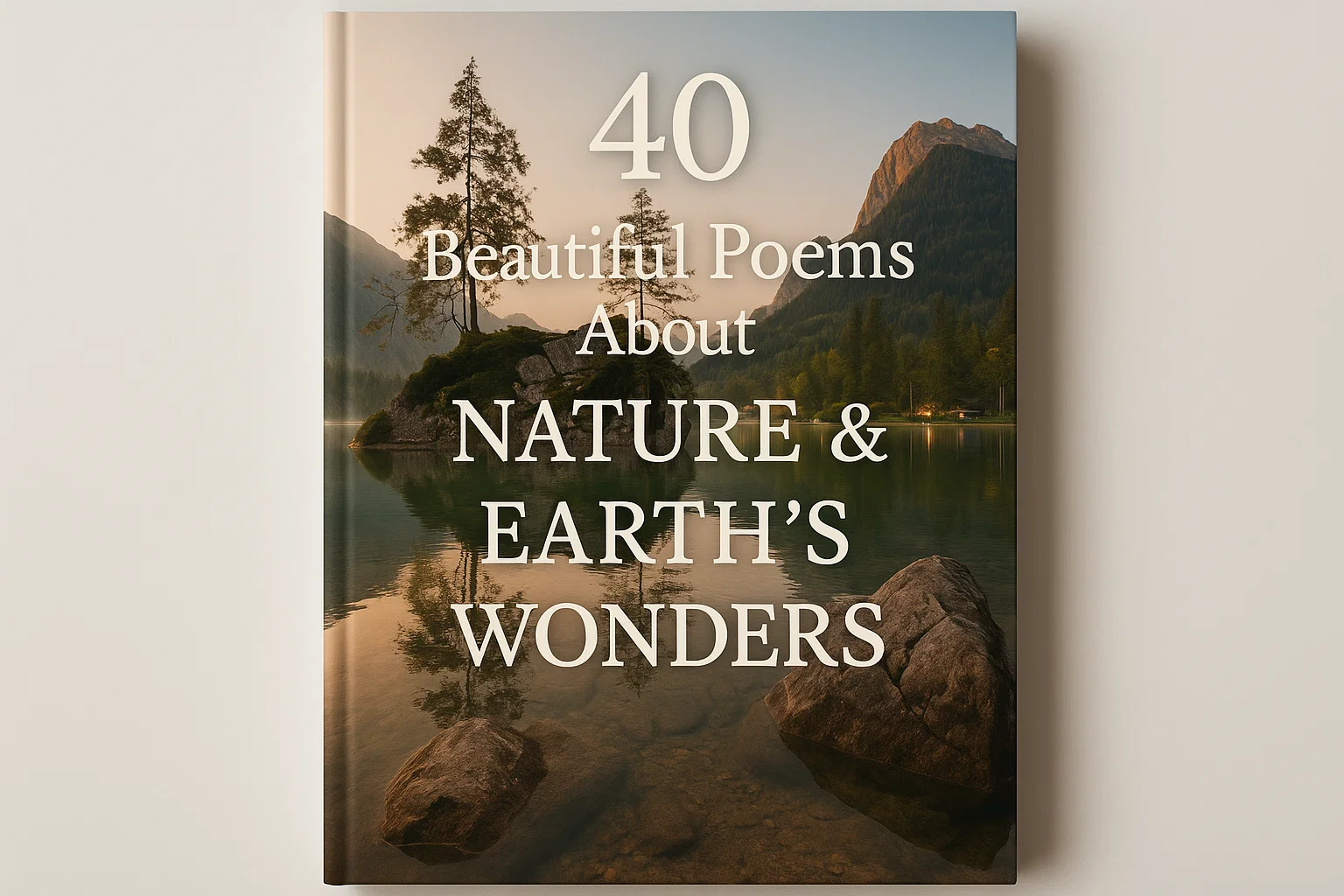
This isn’t just a list. It’s a trek through forty of the most gut-wrenching, grounding pieces of writing dedicated to the earth. Maybe you need the quiet of a pine forest. Maybe you need the violence of a crashing wave. You’ll find it here.
More in Category
Powerful Healing Prayers in the Bible
Key Takeaways
- Nature is Cheaper than Therapy: Poetry offers a serious psychological reset. It lets us process heavy emotions through the lens of the outdoors.
- The Earth Speaks Many Languages: From the stuffy British Romantics to fierce modern Indigenous poets, the perspective shifts constantly.
- Seasons Anchor Us: Reading poems that match the weather outside actually helps ground you in the “now” and quiets the “what ifs.”
- Learn to Look: The best nature poetry teaches us how to stare—really stare—at the world without glancing at a notification.
- Short Hits Hard: You don’t need an epic. Sometimes a three-line Haiku holds more weight than a novel.
Why do we crave verse when life gets too loud?
You know that feeling when the emails pile up and the news cycle feels like a physical weight? You crave the outdoors. It’s not just a preference; it’s a biological imperative. We starve for green. But we can’t always drop everything and drive to a cabin in the woods. So, poetry steps in. It acts as a portal.
Read a few lines about a snowy evening. Watch what happens to your shoulders. They drop. Your breath catches, then slows. You travel without moving.
I keep a beat-up anthology on my nightstand for this exact reason. On nights when my brain won’t shut off, I don’t doom-scroll. I read about wild geese. It works faster than melatonin. The poets below understood something crucial: nature isn’t just a backdrop for our human drama. It is the main character.
Can the Romantics teach us how to actually stop?
We think we invented “burnout.” We didn’t. The Romantic poets of the 18th and 19th centuries were already screaming about it. They saw the factories rising and the smoke choking the sky, and they fought back with ink. They begged us to look at the grass. They believed nature was the only truth left.
1. “I Wandered Lonely as a Cloud” by William Wordsworth
Everyone knows the daffodils poem. But read it again. Ignore the high school English class vibes. Wordsworth isn’t just talking about flowers; he’s describing the “bliss of solitude.” He’s teaching us that a single memory of nature can heal you ten years later while you’re sitting on your couch.
2. “To Autumn” by John Keats
This is the ultimate ode to the harvest. Keats creates a sensory overload. You can practically feel the “moss’d cottage-trees” and taste the over-ripe fruit. He reminds us that getting older (autumn) is just as stunning as being young.
3. “Mont Blanc” by Percy Bysshe Shelley
Shelley takes us to the mountains, and he doesn’t make it cute. This isn’t a gentle nature poem. It’s about the terrifying, sublime power of the cliffs. It reminds us that we are very, very small. Sometimes, that’s a relief.
4. “Lines Composed a Few Miles above Tintern Abbey” by William Wordsworth
Yes, Wordsworth again. He owns this genre. Here, he admits that nature is the anchor of his entire moral being. Without the river and the woods, he’d be lost.
5. “The Rhodora” by Ralph Waldo Emerson
Emerson asks a simple question: Why is a flower beautiful if nobody is there to see it? His answer punches hard: “Beauty is its own excuse for being.” I repeat that line to myself constantly when I feel unproductive.
What secrets do the forests whisper if we shut up?
There is something primal about walking into a forest. The light shifts. The sound dampens. You feel watched, but in a good way. Trees are the lungs of the world, and poets treat them with a specific kind of reverence.
I once got turned around on a trail in the Pacific Northwest. The sun was going down. Panic flared in my chest. But then I stopped. I leaned against a massive Douglas Fir that was probably older than my entire country. The panic drained away. A strange clarity took its place. That’s what these poems capture.
6. “Stopping by Woods on a Snowy Evening” by Robert Frost
The ultimate pause. The narrator has miles to go. He has promises to keep. But he stops anyway. Why? Just to watch the woods fill up with snow. It gives us permission to rest even when we’re busy.
7. “Birches” by Robert Frost
Frost uses the image of bent birch trees to talk about the heavy burdens of adulthood. He wishes he could climb a tree toward heaven, get away for a bit, and then dip back down to earth. Don’t we all want that escape?
8. “The Way Through the Woods” by Rudyard Kipling
This poem feels haunted. It describes a road that nature reclaimed. It’s a gentle, spooky reminder that the earth will eventually take back everything we build.
9. “Trees” by Joyce Kilmer
Critics hate this poem. Readers love it. It’s simple. It’s humble. It has zero cynicism. Sometimes you just need to admit that a poem is lovely, but a tree is a miracle.
10. “When I am Among the Trees” by Mary Oliver
Mary Oliver is basically the patron saint of modern nature poetry. In this piece, she writes that trees emit a kind of holiness. They tell her, “Easy. Easy.” I think we all need to hear that.
How does the ocean mirror our own messy emotions?
If the forest grounds you, the ocean wrecks you. It changes constantly. It crashes. It retreats. It is vast and scary. I find that when I am grieving, I need water poems. They handle the sheer size of the feeling better than land poems do.
11. “Sea-Fever” by John Masefield
“I must go down to the seas again…” The rhythm actually mimics the rocking of a boat. It captures that restless, itching urge to travel, to just be near the wild salt water.
12. “Dover Beach” by Matthew Arnold
This one hits heavier. Arnold listens to the “grating roar” of pebbles on the beach. He thinks about how faith is retreating from the world. It’s a beautiful, sad plea to hold onto each other because the world is uncertain.
13. “The Negro Speaks of Rivers” by Langston Hughes
Hughes connects the human soul to ancient rivers—the Euphrates, the Congo, the Nile, the Mississippi. Water becomes a timeline. It’s history. It’s ancestry flowing through his veins.
14. “maggie and milly and molly and may” by E.E. Cummings
Four girls go to the beach. They find different things—a shell, a star, a crab, a stone. The ending line is a gut punch: “For whatever we lose (like a you or a me) / it’s always ourselves we find in the sea.”
15. “The Rime of the Ancient Mariner” by Samuel Taylor Coleridge
Okay, it’s long. But you have to respect it. The imagery of the ocean—the “painted ship upon a painted ocean”—is unmatched. It’s a cautionary tale: Respect nature. Don’t shoot the albatross.
Do animals understand the earth better than we do?
We spend so much time trapped in our heads. Animals spend their time in the world. They don’t worry about taxes. They don’t doom-scroll. They hunt, they sleep, they live. Poets use animals to highlight a kind of purity we lost.
16. “The Eagle” by Alfred, Lord Tennyson
Six lines. That’s all Tennyson needs. He captures the absolute, terrifying power of a bird of prey. “He clasps the crag with crooked hands…”
17. “The Fish” by Elizabeth Bishop
This is a masterclass in looking. Bishop catches a fish. She stares at it until she sees its history—the hooks caught in its jaw, its “frightening gills.” She feels a moment of profound connection. Then? She lets it go.
18. “Hawk Roosting” by Ted Hughes
Written from the hawk’s perspective. It is arrogant. It is brutal. The hawk doesn’t apologize for killing. It’s a refreshing look at nature without the Disney sugarcoating.
19. “Snake” by D.H. Lawrence
A man sees a snake at his water trough. He knows he should kill it—that’s what society says. But he is awestruck. He calls it a “king in exile.” He chooses wonder over fear.
20. “The Darkling Thrush” by Thomas Hardy
It’s a bleak, dead winter day. Suddenly, a scruffy bird sings a joyful song. The narrator can’t understand why, but that tiny spark of hope changes the whole gray landscape.
Who are the modern voices redefining eco-poetry?
Nature poetry didn’t die with the Victorians. It’s actually more urgent now. Modern poets write about climate change and loss, but also about resilience. These beautiful poems about nature carry a sharper edge.
21. “The Peace of Wild Things” by Wendell Berry
I send this poem to friends when they have panic attacks. Berry writes about coming into the presence of still water and feeling “the grace of the world.” It’s medicine.
22. “Eagle Poem” by Joy Harjo
Harjo, a member of the Mvskoke Nation and a former U.S. Poet Laureate, writes about prayer. She connects us to the sky and the earth in a continuous loop. It’s about being part of the circle.
23. “Catalog of Unabashed Gratitude” by Ross Gay
This poem is an explosion of joy. It’s about orchards, compost, neighbors, and even death. It loves the world so hard it almost hurts to read.
24. “Remember” by Joy Harjo
Harjo appears again because she is essential. “Remember the sky that you were born under.” She commands us to acknowledge our relationships to everything—earth, sun, plants.
25. “Wild Geese” by Mary Oliver
I couldn’t leave this one out. “You do not have to be good.” The geese are flying home regardless of your mistakes. The world offers itself to your imagination. It’s forgiveness in verse.
- Resource: Want to dig deeper? The Academy of American Poets has an incredible archive of eco-poetry.
How do the seasons shape our rhythm?
We mark time by Google Calendars. Our bodies mark time by light and temperature. Seasonal poetry helps us lean into the changes instead of fighting them.
Spring & Summer: The Explosion
26. “Spring” by Gerard Manley Hopkins
Hopkins writes with frantic energy. He sees weeds, thrush eggs, and glassy pear-tree leaves. He captures that raw juice and joy of early May.
27. “A Light exists in Spring” by Emily Dickinson
Dickinson notices a specific slant of light. It only happens in March. It’s a weird, haunting light that “waits.”
28. “The Summer Day” by Mary Oliver
Famous for the grasshopper line. She asks the big question: “Tell me, what is it you plan to do / with your one wild and precious life?”
29. “In Inniskeen Road: July Evening” by Patrick Kavanagh
A quiet poem about walking down a road in Ireland. It captures the pure solitude of a summer twilight.
30. “Shall I compare thee to a summer’s day?” by William Shakespeare
We usually read this as a love poem. But it’s also a critique! Summer is too short. It’s too hot. It’s too windy. The beloved is better because they stay constant.
Autumn & Winter: The Rest
31. “Nothing Gold Can Stay” by Robert Frost
Nature’s first green is gold. It’s the hardest hue to hold. Frost reminds us that beauty is fleeting. That’s exactly why it matters.
32. “Theme in Yellow” by Carl Sandburg
This poem is Halloween. It’s written from the perspective of a pumpkin. It’s fun, atmospheric, and smells like woodsmoke.
33. “Snow-Bound” by John Greenleaf Whittier
This is a long one. But the description of the coming storm is unmatched. You feel the cold seeping through the window panes.
34. “Those Winter Sundays” by Robert Hayden
A poem about a father lighting a fire in the cold morning. It connects the harshness of winter weather with the silent, often unthanked love of a parent.
35. “Spellbound” by Emily Brontë
The night is darkening around her. The winds are freezing. But she cannot go. She is bound by the spell of the winter landscape.
Can a simple Haiku hold a mountain?
Sometimes we talk too much. The Japanese masters understood that nature doesn’t need paragraphs. It needs a snapshot.
36. “The Old Pond” by Matsuo Bashō
Old pond. A frog jumps in. Sound of water. That’s it. But in that silence? You hear the whole universe.
37. “A World of Dew” by Kobayashi Issa
“This world of dew / is a world of dew, / and yet, and yet…” He acknowledges that life is temporary (like dew), but he still mourns the loss of his child.
38. “In the moonlight” by Yosa Buson
“In the moonlight, / The color and scent of the wisteria / Seems far away.” It captures a specific visual trick of the night.
39. “I write, erase, rewrite” by Katsushika Hokusai
“I write, erase, rewrite / Erase again, and then / A poppy blooms.” The struggle of art vs. the effortless perfection of nature.
40. “Lighting one candle” by Yosa Buson
“Lighting one candle / with another candle— / spring evening.” The transfer of light. The continuity of time.
Why is it vital to say these aloud?
Poetry is oral history. It is music. When you read silently, you get the meaning. When you read aloud, you get the feeling. You feel the rhythm of the ocean in Masefield. You feel the crunch of snow in Frost.
I try to read a poem aloud to my daughter every now and then. She doesn’t always understand the words. But she settles down. She listens to the cadence. She understands that language can be a landscape.
These beautiful poems about nature are tools. Use them to pry open your eyes when you’ve been staring at screens too long. Use them to find your breath. Use them to remember that you are made of the same carbon as the stars and the same salt water as the sea.
Go outside. Take a book. Read a line. Look at a leaf. Repeat.
FAQs
Why do many people turn to poetry about nature during times of emotional overwhelm?
Poetry about nature offers a psychological reset by helping us process heavy emotions through the lens of the outdoors, providing grounding and a sense of belonging to the wild, spinning world.
How can reading nature poetry help us be more present in the moment?
Reading poems that match the seasons or weather outside anchors us in the present, quiets intrusive thoughts, and helps us embrace the ‘now’ through the power of lyrical imagery.
What insights do Romantic poets offer regarding detachment and slowing down?
Romantic poets like Wordsworth and Keats explored themes of solitude, beauty, and reverence for nature, urging us to look at the natural world as a source of truth and a refuge from modern burnout.
Why is reading poetry aloud significant for experiencing its full impact?
Reading poetry aloud conveys rhythm and feeling, allowing the listener to experience the landscape of language, rhythm, and emotion embedded in nature poetry, thus deepening comprehension and connection.
In what ways do animals and birds in poetry reflect our understanding of the earth?
Poets use animals and birds to highlight a primal purity and power, capturing their instinctual relationship with the earth and offering a contrast to human overthinking and disconnect.