

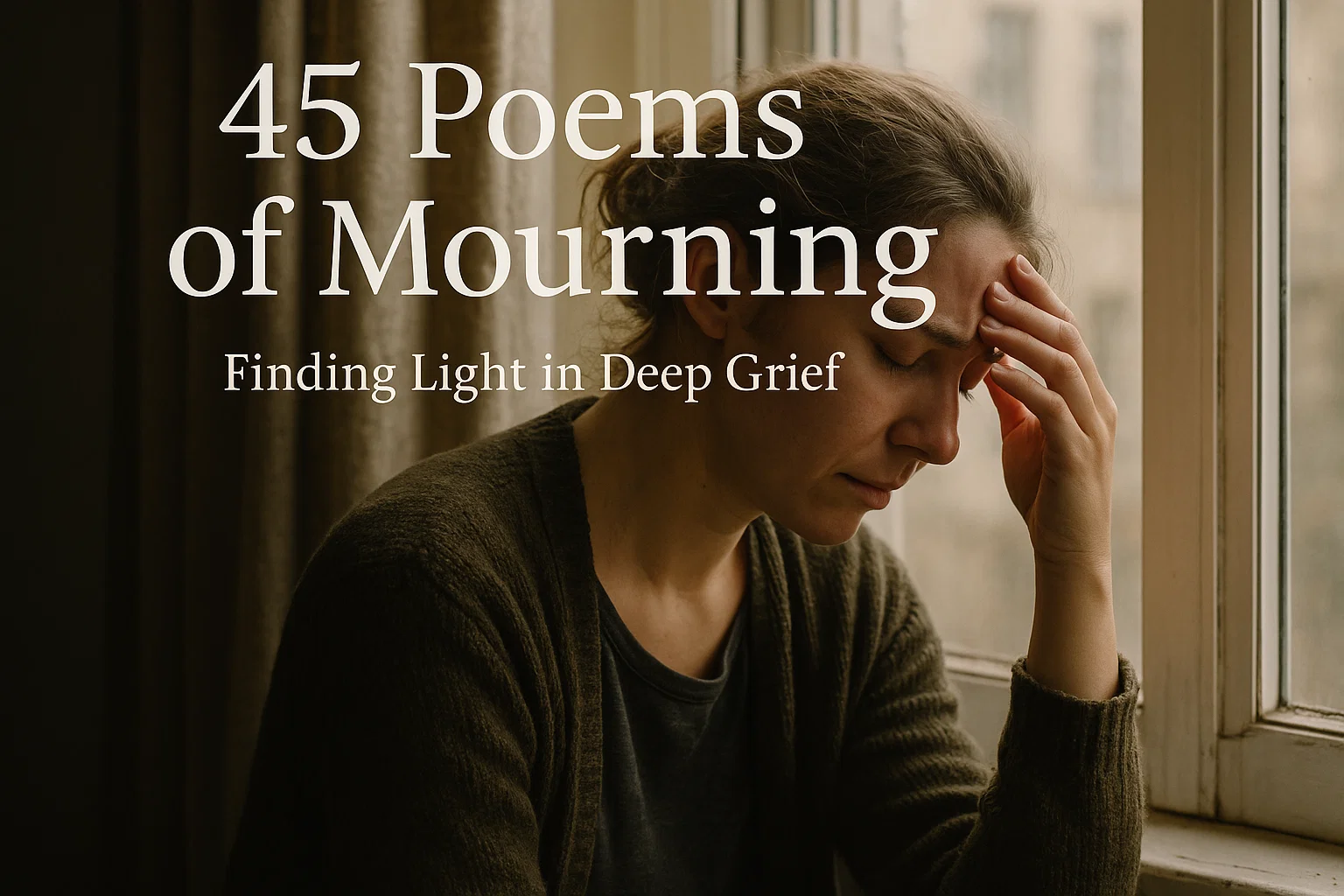
The morning after my mother’s funeral, my kitchen was too quiet. Not the peaceful kind of quiet. The suffocating kind. The coffee maker hissed, a car drove by, but everything felt wrong. Off-key. My husband asked how I was doing, and I just stared at him. The words turned to ash in my mouth. “I’m sad” felt pathetic. “I miss her” didn’t even scratch the surface.
Grief had stolen my vocabulary. I was drowning, and I didn’t have a single word strong enough to grab onto.
That afternoon, mostly to stop pacing, I pulled an old anthology off the shelf. I flipped it open to Mary Oliver. Three lines in, and I finally exhaled. She said exactly what I had been trying to scream for three days. That’s the utility of poems of mourning. They don’t fix you. But they hand you a voice when yours is shattered. They build a bridge back to the land of the living when you’re stuck on an island of sorrow.
More in Category
Powerful Healing Prayers in the Bible
Key Takeaways
- You aren’t crazy, and you aren’t alone. Poetry proves that people have been surviving this specific hell for centuries.
- It’s okay to be furious. Mourning isn’t just crying; it’s rage, numbness, and confusion. Poems validate the ugly parts, not just the sad parts.
- Rhythm regulates you. The meter of a poem can actually slow down your heart rate when panic sets in.
- Borrow their words. When you can’t explain the pain to your friends, hand them a poem. Let it speak for you.
- Love survives. Even the darkest elegies usually harbor a tiny, stubborn spark of hope.
Why does “I’m sorry for your loss” feel so useless?
Ever notice how clumsy people get around you now? We live in a culture obsessed with fixing things fast. Grief refuses to be fixed. It refuses to be fast. So when we lose someone, we enter this weird, liminal space. The grocery store looks hostile. The sun is offensive because it dares to shine. We feel like aliens watching humans walk their dogs.
I needed a translator for my own life.
Poetry steps into that gap. It doesn’t ask for efficiency. It demands presence. Poems of mourning force us to slow down. They make us sit with the jagged edges. A poem doesn’t say, “Move on.” It pulls up a chair in the dark and says, I know. It sucks. Look at how terrible and beautiful it is.
We turn to verse because prose fails us. Prose is for explaining taxes or ordering dinner. Poetry is for the gut. When you read a stanza that nails that specific ache in your chest, the isolation cracks a little. You realize someone else felt this exact shade of blue a hundred years ago.
Can reading a few lines actually stop the hurting?
I used to think poetry was for academics in tweed jackets. But in the trenches of loss, I found it was survival gear.
It’s not magic; it’s biology. Reading poetry engages the parts of the brain tied to memory and music. The rhythm—the cadence—mimics a heartbeat. It mimics the rocking motion of a mother holding a child. It is somatic. It physically calms you down.
When you read a poem about loss, you aren’t just consuming content. You’re participating in a ritual. You let the poet’s strength carry you for a minute because your legs are tired. I found that reading just one poem with my coffee gave me enough air to face the emails and the sympathy cards. It didn’t cure the pain. But it made the pain companionable. It turned a monster into a roommate.
Who are the heavy hitters in grief poetry?
If you’re new to this, don’t worry about reading everything. Just find the voice that sounds like you.
Emily Dickinson: The Queen of Isolation
You can’t do this without Emily. She wore white, stayed in her room, and wrote with a scalpel. She didn’t fear death; she studied it. She understood that grief is a “formal feeling”—stiff, ceremonious, and freezing.
W.H. Auden: The Voice of Total Despair
When you want to smash every clock in the house and scream at the sky, you want Auden. He captures that refusal to accept that the world is still turning.
Mary Oliver: The Woods Walker
If Dickinson is the brain and Auden is the broken heart, Mary Oliver is the soul. She takes your grief into the forest. She shows you how death fits into the cycle of rot and rebirth. She doesn’t ask you to “get over it.” She asks you to change with it.
The 45 Poems You Should Read When the Lights Go Out
I’ve grouped these poems of mourning by the type of loss, because let’s be real—losing a parent is a different beast than losing a partner.
What do you read when you lose a parent?
This is the loss of your anchor. The ceiling of your childhood is gone.
1. “Piano” by D.H. Lawrence
A sudden memory of his mother triggered by music. It captures that desperate longing to be small and protected again.
2. “Do Not Go Gentle into That Good Night” by Dylan Thomas
Furious and beautiful. I read this when my dad was fading. The rage in it feels validating when everyone else tells you to be “peaceful.”
3. “Clearances” by Seamus Heaney
A sonnet about peeling potatoes with his mother. It finds the holy in the mundane stuff we actually miss.
4. “My Mother’s Clothes” by Toi Derricotte
The brutal, practical task of sorting through closets. It’s the physical weight of grief.
5. “Kaddish” by Allen Ginsberg
Raw, chaotic, and messy. Read this if your relationship with your parent was complicated or difficult.
6. “Those Winter Sundays” by Robert Hayden
A gut-punch about a father’s quiet, thankless love. It heals the regret of not saying “thank you” enough.
7. “The Lanyard” by Billy Collins
A slightly lighter take on the impossibility of repaying a mother. It permits a small smile.
8. “Elegy for My Father, Who Is Not Dead” by Andrew Hudgins
This explores the anticipation of grief. The long, slow goodbye of aging.
How do you survive the loss of a partner?
This tears the self in half. It’s the empty side of the bed.
9. “Funeral Blues” by W.H. Auden
The anthem of heartbreak. “He was my North, my South, my East and West.” Total devastation.
10. “The Widow’s Lament in Springtime” by William Carlos Williams
Contrasts the colorful, blooming world with the cold winter inside your chest.
11. “Separation” by W.S. Merwin
Three lines long. Punches you right in the stomach. “Your absence has gone through me / Like thread through a needle.”
12. “One Art” by Elizabeth Bishop
She tries so hard to convince herself she’s mastering loss, then breaks down in the last line. Perfect for the denial stage.
13. “By the Roadside” by Walt Whitman
Whitman’s tenderness is unmatched. He holds the dead with such reverence.
14. “Defining the Magic” by Charles Bukowski
A raw, gritty look at the void left behind in a quiet house.
15. “Failing and Flying” by Jack Gilbert
Challenges the idea that an ending is a failure. It celebrates the flight, even if you crashed.
16. “Scheherazade” by Richard Siken
“Tell me we’re dead and I’ll love you even more.” Desperation to keep the connection alive at any cost.
17. “Recuerdo” by Edna St. Vincent Millay
Clinging to a specific memory of a night spent back and forth on a ferry.
What words exist for the loss of a child?
This is the grief that defies nature. It’s out of order.
18. “On My First Son” by Ben Jonson
Written in 1603, but the pain is fresh. He calls his son “his best piece of poetry.”
19. “Mid-Term Break” by Seamus Heaney
The devastating restraint here kills me. The “four foot box, a foot for every year.”
20. “A Refusal to Mourn the Death, by Fire, of a Child in London” by Dylan Thomas
Heavy and complex. He refuses to cheapen the death with easy platitudes.
21. “Stillbirth” by Laure-Anne Bosselaar
Gives a voice to the silent grief of a life that never started.
22. “Introduction to the Songs of Experience” by William Blake
Touches on the loss of innocence and the extreme vulnerability of youth.
23. “Funeral” by Ralph Waldo Emerson
Emerson lost his son young; he tries to find cosmic meaning in a senseless tragedy.
24. “Boy at the Window” by Richard Wilbur
A metaphor for the separation between the warm inside and the cold, unknown outside.
Can poetry handle the death of a friend?
Friends are the chosen family. They hold our history.
25. “In Memoriam A.H.H.” by Alfred, Lord Tennyson
Written over 17 years for his best friend. “Tis better to have loved and lost…” came from here.
26. “Adonais” by Percy Bysshe Shelley
Written for John Keats. Grand, dramatic, and full of fire.
27. “O Captain! My Captain!” by Walt Whitman
Mourning a leader, but mostly mourning a friend and guide.
28. “Dirge Without Music” by Edna St. Vincent Millay
“I am not resigned.” For when you are angry that such a vibrant person is just gone.
29. “To Waken an Old Lady” by William Carlos Williams
Watching a friend fade, but celebrating their resilience.
30. “We Real Cool” by Gwendolyn Brooks
The tragedy of friends lost too young to the streets. Short, rhythmic, jazz-like.
31. “Because I could not stop for Death” by Emily Dickinson
She treats Death like a gentleman caller, a friend accompanying her.
32. “Casualty” by Seamus Heaney
Mourning a friend killed in conflict. Explores the survivor’s guilt.
What about the dog (or cat)?
I cried harder for my retriever than I did for my uncle. Don’t let anyone shame you for this.
33. “The Power of the Dog” by Rudyard Kipling
Warns us that giving your heart to a dog is signing up for heartbreak. We do it anyway.
34. “A Dog Has Died” by Pablo Neruda
Neruda treats his dog with the same reverence he treats the ocean.
35. “The House Dog’s Grave” by Robinson Jeffers
Perspective from the dog itself. Simple, loyal wisdom.
36. “Cat’s Dream” by Pablo Neruda
Captures the wild, tiger-spirit that lived in your living room.
37. “Last Words to a Dumb Friend” by Thomas Hardy
“Dumb” meaning unable to speak, not stupid. Hardy’s grief is palpable here.
Where do we find hope without toxic positivity?
We need poems that lift the chin, not fake smiles.
38. “Wild Geese” by Mary Oliver
“You do not have to be good.” Reminds you the world is still calling to you.
39. “The Peace of Wild Things” by Wendell Berry
When grief turns into anxiety, this is your prescription for calm.
40. “Still I Rise” by Maya Angelou
Usually about oppression, but works beautifully for the oppression of sorrow.
41. “Hope is the thing with feathers” by Emily Dickinson
Hope perches in the soul and asks for nothing. It just waits.
42. “Invictus” by William Ernest Henley
For when you need to feel unbreakable and tough.
43. “Kindness” by Naomi Shihab Nye
You realize that real kindness only comes after you’ve known real sorrow.
44. “When Great Trees Fall” by Maya Angelou
Acknowledges the shaking of the foundation but promises that peace blooms eventually.
45. “Death is Nothing at All” by Henry Scott Holland
Some find this denial. Others find it comforting to think they are just in the next room.
Why does nature imagery work so well?
Did you notice the pattern? Geese, trees, snow, dirt. When we grieve, we feel “unnatural.” Broken. Nature reminds us that death is the rent we pay for living.
I remember walking in the park a month after the funeral. I saw a dead leaf rotting into the mud, and right next to it, a green shoot pushing up. Cliché? Maybe. But in that moment, it felt profound. Poems of mourning use nature to ground us.
Mary Oliver doesn’t romanticize nature; she respects its brutality. By connecting our loss to the universal movements of the earth, we feel less like a mistake and more like a part of the season.
Is it okay to be angry?
Hell yes.
We think funeral poems need to be soft and weepy. Screw that. Dylan Thomas tells you to rage. Millay refuses to eat the “loveless dust.” If you want to scream, find poems with hard consonants and broken rhythms.
I spent weeks furious at the doctors, at the universe, at my mom for leaving. Reading poems that mirrored that anger stopped me from feeling like a monster. It validated the fire. Let the poetry scream for you when you’re too tired to raise your voice.
Want to try writing your own?
You don’t need to be a “writer.” You just need to bleed a little on paper. Writing is an exorcism.
Start small. And for the love of God, do not rhyme. Rhyming forces you to say things you don’t mean just to match the sound “love” with “dove.”
Try this:
- Pick an object. His watch. Her scarf. The leash.
- Describe it. Smell, weight, texture.
- Write a memory.
- End with where the object is right now.
That’s a poem. It gets the poison out of your system.
Why keep the book on the nightstand?
Grief isn’t a straight line. It’s a spiral. You feel fine for months, then a song comes on the radio and you’re back at square one. I still keep my collection of poems of mourning nearby.
We return to them because our relationship with the dead keeps changing. The poem I read at the funeral means something totally different to me five years later. “When Great Trees Fall” used to make me cry; now it makes me feel steady.
These 45 poems aren’t just for the funeral home. They’re for the anniversaries, the birthdays, and the quiet Tuesday afternoons when the memory of a laugh catches you off guard.
Finding Your Light
If you’re reading this, I’m sorry. I know the weight. I hope you found at least one line in this list that serves as a handhold.
Grief is the price of love. It’s a steep price. But as these poets show us, we don’t pay it alone. We pay it in the company of kings, soldiers, and spinsters who looked into the void and decided to write something down.
Take these words. Let them be a lantern. You’ll find your way.
Explore more resources on grief and healing at The Harvard Divinity School’s collection on grief.
FAQs
Why are poems of mourning helpful after experiencing loss?
Poems of mourning help by giving a voice when your own words are shattered, providing validation for the complex emotions of grief, and building a bridge back to life by acknowledging the pain and beauty of loss.
How can poetry assist in the grieving process?
Poetry engages the brain’s memory and music centers, offering physical comfort and a ritual for processing grief, making pain more bearable and turning it into a companion rather than a monster.
Who are some notable poets for grief poetry, and what are their unique perspectives?
Emily Dickinson explores grief as a formal feeling of stiffness; W.H. Auden captures despair and refusal to accept loss; Mary Oliver leads grief into the cycle of nature, encouraging change and acceptance.
What should I read if I have lost a parent, and can you recommend specific poems?
For losing a parent, poems like ‘Piano’ by D.H. Lawrence, ‘Do Not Go Gentle into That Good Night’ by Dylan Thomas, ‘Those Winter Sundays’ by Robert Hayden, and ‘Kaddish’ by Allen Ginsberg offer various reflections on grief, rage, gratitude, and memory.
Is it okay to feel angry when grieving, and how can poetry validate this emotion?
Yes, it is completely okay to feel angry; poetry can validate and express this anger through hard consonants, broken rhythms, and raw honesty, helping to release intense emotions that prose might suppress.