
I can still smell that library basement. It wasn’t the romantic “old book” smell people talk about on Instagram; it smelled like damp carpet and vanilla and forty years of silence. I was nineteen, sitting cross-legged on the gray floor, skipping class, holding a book that was falling apart at the spine. I read a line by Auden and felt the floor literally—physically—drop out from under me. That’s the thing about fascinating poems. They don’t just sit there on the page waiting for you to analyze them for a grade. They reach out, grab you by the throat, and demand you pay attention.
We live in a loud world. My phone is currently buzzing with three different group chats, the news is a disaster, and my inbox is a graveyard of unread emails. We need an anchor. Over the last two decades, I’ve hoarded verses the way some of my friends hoard vintage shoes. I keep them in the Notes app on my phone, scribbled on the backs of receipts, and tucked into the edges of my brain for when the panic sets in.
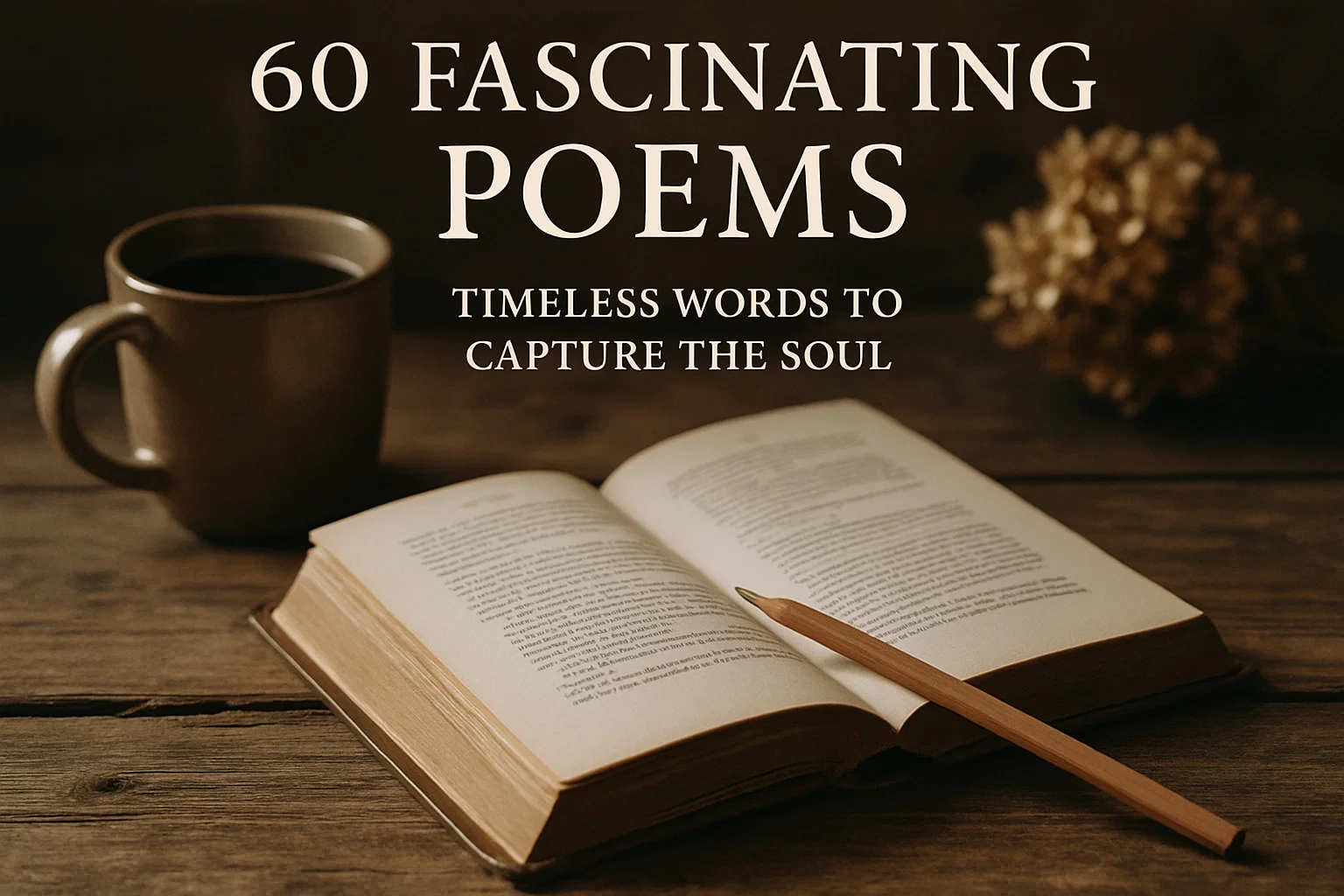
If you’re looking for something to hold onto, you’re in the right place. I’ve pulled together sixty of the most arresting, gut-wrenching, beautiful pieces of writing I know. These aren’t for a test. They’re for survival.
More in Poems Category
Poems Celebrating Bonds of Love
Key Takeaways
- It’s Not About Being Smart: You don’t need a PhD to get these. If you have a pulse and a broken heart (or a full one), you’re qualified.
- Read It Out Loud: Seriously. Whisper it in your kitchen. Poetry is music; it needs breath to work.
- The “Best” is Subjective: The right poem is just the one that makes you say, “Wait, you felt that too?”
- Old vs. New: We’re mixing Rumi with Instagram poets because truth doesn’t have an expiration date.
- Utility: Use these for grief, for weddings, for Tuesday mornings when you just can’t get out of bed.
Why do some words stick to your ribs?
Ever read a sentence and have to put the book down because it felt like someone was spying on your internal monologue? That’s the sweet spot. When I went through a really nasty breakup in my twenties—the kind where you stop eating and stare at the ceiling for hours—I thought I was the only person in human history to feel that specific, hollow ache.
Then I read Jack Gilbert. And suddenly, I wasn’t alone. I was part of a long, tragic, beautiful lineage of people who loved the wrong person. Fascinating poems act like mirrors. They reflect our terror and our joy back to us with a kind of holy shine. We don’t read to escape real life; we read to find out how to survive it.
Which romantic verses actually get love right?
Love poetry is tricky. It usually veers into cheesy greeting card territory, and I can’t stand that. Real love isn’t just soft focus and roses; it’s gritty. It’s arguing about the dishes and then laughing until your sides hurt. It’s fear. The best love poems acknowledge the stakes.
1-10: The Romantics and The Realists
You can’t make a list like this without Pablo Neruda. But forget the happy stuff; read Sonnet XVII. He talks about loving someone “in secret, between the shadow and the soul.” It’s dark and desperate and absolutely perfect.
And then there’s e.e. cummings. I used to hate his lack of punctuation until I fell in love and realized that’s exactly what it feels like—a run-on sentence with no breath.
Here are ten that actually get it:
- Pablo Neruda – Sonnet XVII (The gold standard for deep, secret love.)
- e.e. cummings – somewhere i have never travelled,gladly beyond
- Elizabeth Barrett Browning – How Do I Love Thee? (Okay, it’s a classic, but read it slowly. It holds up.)
- W.B. Yeats – When You Are Old (Read this to someone you plan to grow gray with.)
- Frank O’Hara – Having a Coke with You
- Margaret Atwood – Variations on the Word Sleep (This one is haunting. “I would like to be the air that inhabits you for a moment only.”)
- Shakespeare – Sonnet 116
- Rumi – The Minute I Heard My First Love Story
- John Keats – Bright Star
- Carol Ann Duffy – Valentine
I have a soft spot for Having a Coke with You. I read it to my now-husband on our second date. We were at a diner, eating greasy fries, and I felt stupidly vulnerable pulling out a book. But he stopped chewing. He listened. Frank O’Hara captures that specific rush where just sitting next to someone feels better than looking at the greatest art in Europe.
Can heartbreak look beautiful on paper?
If love is the peak, heartbreak is the valley. And honestly? The valley produces better art. Happiness writes white; grief writes in neon. When you lose someone—whether they died or just walked away—you need words that are heavy enough to weigh down the grief so it doesn’t float you away.
11-20: For the Brokenhearted
I remember sitting in a hospital waiting room years ago, staring at the vending machine lights, and reciting Dylan Thomas in my head. Do not go gentle. It didn’t fix anything—poetry doesn’t fix death—but it gave my anger a rhythm. It gave me something to march to.
- W.H. Auden – Funeral Blues (If you’ve seen “Four Weddings and a Funeral,” you know this one hurts.)
- Sylvia Plath – Mad Girl’s Love Song
- Edna St. Vincent Millay – Time Does Not Bring Relief; You All Have Lied (The title says it all.)
- Dylan Thomas – Do not go gentle into that good night
- Jack Gilbert – Failing and Flying
- Derek Walcott – Love After Love
- Mary Oliver – In Blackwater Woods
- Emily Dickinson – After great pain, a formal feeling comes
- Rainer Maria Rilke – The Panther
- Lord Byron – When We Two Parted
Derek Walcott’s Love After Love is the antidote to a bad breakup. He commands you to sit down and feast on your own life. It reminds women, specifically, that we are whole entities without a partner. I’ve sent this poem to more crying girlfriends than I can count.
How does nature whisper its secrets through verse?
We spend way too much time looking at blue light. I forget sometimes that I’m an animal, that I belong to the dirt and the oxygen, not the Zoom call. Nature poets drag us back. They remind us that our anxieties are tiny compared to the lifespan of a redwood tree.
21-30: The Wild and The Green
Mary Oliver is the queen of this. She could watch a grasshopper eat sugar out of her hand and turn it into a theological argument. Her famous question—”Tell me, what is it you plan to do with your one wild and precious life?”—actually keeps me up at night.
- Mary Oliver – The Summer Day
- Wendell Berry – The Peace of Wild Things
- Robert Frost – Birches
- William Wordsworth – I Wandered Lonely as a Cloud
- Walt Whitman – Song of Myself (Section 52 is where the magic is.)
- Langston Hughes – The Negro Speaks of Rivers
- Sara Teasdale – There Will Come Soft Rains
- Robert Frost – Stopping by Woods on a Snowy Evening
- Joy Harjo – Eagle Poem
- Gerard Manley Hopkins – Pied Beauty
I keep The Peace of Wild Things taped to my bathroom mirror. On mornings where the headlines are a disaster and my kids are screaming, I read about the wood drake resting on the water. It’s a literal blood pressure medication.
Who are the modern voices shaking up the world?
A lot of people think poetry died when the Victorians stopped wearing corsets. They are dead wrong. The modern scene is exploding. It’s loud, it’s diverse, and it’s dealing with the internet, racism, gender, and the weirdness of being alive right now. These fascinating poems aren’t polite.
31-40: The Contemporary Trailblazers
Ocean Vuong writes sentences that feel like they might break if you touch them too hard. Warsan Shire writes lines you want to get tattooed on your ribs. These poets aren’t hiding behind metaphors; they are screaming the truth.
- Maya Angelou – Still I Rise (Required reading for existing.)
- Warsan Shire – Home (This explains the refugee crisis better than any news report.)
- Ocean Vuong – Someday I’ll Love Ocean Vuong
- Ada Limón – Instructions on Not Giving Up
- Maggie Smith – Good Bones
- Amanda Gorman – The Hill We Climb
- Rupi Kaur – Milk and Honey (Love her or hate her, she changed the game.)
- Hanif Abdurraqib – How Can Black People Write About Flowers at a Time Like This
- Tracy K. Smith – Sci-Fi
- Clint Smith – Something You Should Know
Good Bones by Maggie Smith went viral a few years ago for a reason. As a mother, that poem tears me apart. It nails that specific, terrifying job of selling the world to your children while knowing exactly how broken the world actually is.
Can a short poem really pack a punch?
You don’t need twenty pages to break a heart. Sometimes, you just need three lines. The Japanese Haiku masters knew this, and modern minimalists know it too. Brevity is confidence. It’s walking into a room, saying one thing, and walking out.
41-50: Small but Mighty
William Carlos Williams wrote about a red wheelbarrow and changed literature forever. Why? Because he forced us to look at the object. Just the object. No fluff.
- William Carlos Williams – The Red Wheelbarrow
- Ezra Pound – In a Station of the Metro
- Matsuo Bashō – The Old Pond
- Gwendolyn Brooks – We Real Cool
- Langston Hughes – Harlem (A Dream Deferred)
- Lucille Clifton – won’t you celebrate with me
- Emily Dickinson – I’m Nobody! Who are you?
- Robert Frost – Fire and Ice
- Margaret Atwood – You Fit Into Me
- Stevie Smith – Not Waving But Drowning
You Fit Into Me by Atwood is four lines long. It starts out sounding like a greeting card and ends like a horror movie. It makes me laugh every single time because of the sheer audacity. It reminds me that women are allowed to be sharp, witty, and dangerous.
What about the ones that make us question reality?
Then you have the philosophers. The mystics. The poets who stare into the void at 3 AM and ask, “What is all this?” These poems deal with God, the universe, and the bizarre nature of consciousness.
51-60: The Mystics and The Thinkers
T.S. Eliot captured modern anxiety before modern anxiety was even a thing. Khalil Gibran sounds like a religious text but feels like a conversation with a wise friend.
- T.S. Eliot – The Love Song of J. Alfred Prufrock
- Khalil Gibran – On Marriage
- John Donne – No Man Is An Island
- William Blake – The Tyger
- Allen Ginsberg – Howl
- Charles Bukowski – The Laughing Heart
- Rudyard Kipling – If—
- Robert Browning – My Last Duchess
- Samuel Taylor Coleridge – Kubla Khan
- Dante Alighieri – The Divine Comedy (Just start with the opening lines of Inferno.)
The Laughing Heart by Bukowski is my personal fight song. “Your life is your life. Know it while you have it.” It’s aggressive optimism. It demands you take ownership of the fact that you are here, right now, breathing.
How do you actually bring this stuff into your life?
Look, I know this list is huge. Don’t let it overwhelm you. You don’t have to read all sixty of these today. You don’t even have to like all of them.
Start small. Buy a cheap notebook—the kind that costs a dollar. When you hear a line in a song, or read a verse here that sparks a light in your belly, write it down. Make the words yours.
For a deeper dive, I can’t recommend the Poetry Foundation enough. It’s a massive, free archive where you can lose yourself for hours.
I keep a beat-up anthology in the glove compartment of my car. When I’m early for school pickup, or stuck waiting for a train, I read one page. It changes the texture of my day. It reminds me that I’m alive, that I’m feeling things, and that I’m not the only one.
Poetry isn’t a secret code for the elite or the academics. It’s just the human heartbeat, written down. Go find yours.
FAQs
How can poetry serve as a form of emotional survival?
Poetry can act as a vital emotional anchor, providing words and expressions that resonate with our feelings, helping us process grief, joy, or despair, and reminding us that we are not alone in our experiences.
Is it necessary to be highly educated to understand or appreciate poetry?
No, you do not need a PhD to engage with poetry; if you have a pulse and a broken or full heart, poetry is accessible and can speak to you regardless of your educational background.
What are some effective ways to incorporate poetry into my daily life?
You can start by carrying a notebook to jot down lines that resonate with you, reading poetry out loud, or keeping poetry accessible in places like your car or kitchen to remind yourself of its comfort and truth.
How do modern poets differ from traditional ones, and why is their poetry important today?
Modern poets often address contemporary issues like internet culture, racism, and gender, using diverse voices and raw honesty, making their poetry more relevant and impactful in today’s world.
Can short poems be as powerful as longer ones?
Yes, short poems can be incredibly potent; their brevity forces clarity and confidence, often delivering profound emotional punch with just a few lines, exemplified by the Japanese haiku and poets like William Carlos Williams.